
Choosing which political data to trust is rarely straightforward, especially when headlines from Washington, Brussels, or Beijing seem to contradict one another. For international relations students and emerging analysts, finding reliable data sources forms the bedrock of strong political analysis. This guide highlights trusted methods and practical steps for identifying, organizing, and evaluating the information that shapes meaningful conclusions in global affairs.
Table of Contents
- Step 1: Establish Reliable Data Sources
- Step 2: Collect And Organize Relevant Political Information
- Step 3: Evaluate Credibility And Context Of Sources
- Step 4: Synthesize Findings Into Actionable Insights
- Step 5: Validate Conclusions With Cross-Verification
Quick Summary
| Key Point | Explanation |
|---|---|
| 1. Use Reliable Data Sources | Establish a foundation for analysis by selecting trustworthy sources like government statistics and peer-reviewed databases. |
| 2. Implement a Collection Strategy | Gather relevant information systematically by focusing on specific elements like policy changes or voting patterns to avoid irrelevant data. |
| 3. Apply the CRAAP Test | Evaluate the credibility of sources using Currency, Relevance, Authority, Accuracy, and Purpose to ensure the quality of information. |
| 4. Synthesize Insights Effectively | Identify patterns and key themes from your data, organizing them around central questions to derive actionable insights for decision-making. |
| 5. Validate Conclusions Thoroughly | Use triangulation to cross-check findings against multiple sources or methods, ensuring the robustness and reliability of your final analysis. |
Step 1: Establish reliable data sources
You're about to build the foundation for your entire analysis. The data sources you choose will determine whether your conclusions hold weight or crumble under scrutiny. Getting this right matters more than moving fast.
Start by understanding what counts as reliable. Government statistics offices, international organizations, and peer-reviewed databases form your strongest foundation. These sources typically have transparent methodologies, clear collection processes, and institutional accountability.
Next, apply a practical assessment framework. When evaluating any source, consider three critical dimensions:
- Content validity - Does the data actually measure what you need it to measure?
- Reliability of collection - Was the data gathered using consistent, documented methods?
- Convergent validity - Do multiple independent sources report similar findings?
This approach helps you move beyond gut instinct. A three-component approach to assessing data quality integrates these methods to evaluate whether your sources deserve trust.
Prioritize sources that document their limitations openly. Good data sources acknowledge potential biases, sampling methods, and confidence intervals. If a source claims perfection, that's a red flag.
Here's a comparison of common data source types and their analytical strengths:
| Data Source Type | Strengths for Analysis | Potential Limitations |
|---|---|---|
| Government data | High credibility, large samples | May be slow to update, political bias |
| International organizations | Cross-country comparability | May use aggregate estimates |
| Peer-reviewed databases | Rigorous methodology | Limited scope, academic jargon |
| Media reports | Up-to-date events information | Risk of bias, less methodological rigor |
Start building your source inventory right now. List what data you currently have access to, identify what gaps exist, and rank those gaps by importance to your analysis. This structured approach prevents you from relying on whatever information happens to be convenient.
Your analysis is only as strong as your weakest data source. Spend time upfront establishing reliability, and your conclusions will withstand criticism.
Pro tip: Create a simple spreadsheet tracking each source's publication date, update frequency, methodology, and any known limitations—this becomes your reference guide when new data arrives and helps you spot when sources become outdated.
Step 2: Collect and organize relevant political information
Now that you've identified reliable sources, it's time to actively gather the information you need. This step transforms your sources into usable data that supports solid analysis.

Begin with a clear collection strategy. Know exactly what you're looking for before you start gathering. Are you tracking policy announcements, voting patterns, public statements, or institutional decisions? Specificity prevents you from drowning in irrelevant information.
Use both digital and traditional tools to maximize your reach. Digital databases offer speed and searchability, while traditional sources like government archives and institutional records provide depth. Information-gathering processes and techniques highlight how strategic planning and diverse tools strengthen your collection efforts.
Organize as you collect, not after. Create a system that captures:
- Source and date of the information
- Key details or quotes relevant to your analysis
- Context about where this fits in your overall picture
- Any limitations or caveats about the data
This prevents the common mistake of gathering everything and organizing nothing. You'll waste hours later trying to remember where you found something or what it meant.
Separate your qualitative and quantitative data from the start. Numbers need different handling than narrative information, and keeping them distinct makes analysis cleaner. Use spreadsheets for numbers, document folders for text and interviews, and note systems for your interpretations.
Develop a consistent naming convention for your files and folders. Include the date, topic, and source type so you can find information months later without guessing.
Your collection system becomes your most valuable asset when patterns emerge and you need to trace back to original sources.
Pro tip: Set up a simple tagging or categorization system within your first week—whether using folder structures, database fields, or document tags—because reorganizing hundreds of items later costs far more time than getting organized upfront.
Step 3: Evaluate credibility and context of sources
You've collected information from multiple sources, but not all sources deserve equal weight. This step teaches you to separate credible sources from questionable ones using practical evaluation methods.
Apply the CRAAP test to every source you're considering. This framework checks five dimensions that matter for political analysis:
- Currency - Is the information recent enough for your analysis?
- Relevance - Does it directly address your research question?
- Authority - Who created this source and what are their credentials?
- Accuracy - Can you verify the claims through other reputable sources?
- Purpose - What is the source's intent, and could bias influence the content?
Evaluating sources systematically using frameworks like CRAAP helps you identify trustworthy information and spot potential problems early.
Go beyond surface-level assessment. Investigate the author's qualifications and institutional affiliation. A policy analysis carries more weight when written by someone with relevant expertise and published through a credible organization. Check whether authors cite their own sources, which indicates they're building on existing research rather than inventing claims.
Examine the publication context carefully. Peer-reviewed academic journals undergo rigorous scrutiny before publication. Government reports have institutional accountability. News from opinion columns lacks the same verification process. Understanding these differences shapes how much you should trust each source.
Use lateral reading to validate information. When you encounter a claim you're unsure about, open a new tab and search for the same information in other sources. If multiple independent, reputable sources report the same fact, your confidence increases. If sources contradict each other, dig deeper to understand why.
Consider the timing and scope of your sources. A source from 2020 might have become outdated by 2024 depending on your topic. Similarly, a narrow study of one region shouldn't be treated as evidence for global patterns.
The most persuasive sources prove their claims through transparent methods, acknowledge limitations, and welcome scrutiny.
Pro tip: Keep a simple credibility checklist beside you while researching, rating each source on the five CRAAP dimensions—this prevents you from rationalizing away red flags when you find information that supports your hypothesis.
Step 4: Synthesize findings into actionable insights
You've gathered credible information and evaluated it carefully. Now comes the critical work of turning raw data into insights that actually matter for political analysis and decision-making.
Start by identifying patterns across your sources. Look for themes that appear repeatedly, contradictions that demand explanation, and gaps where evidence is thin. Raw facts become insights when you connect them and understand what they mean together.
Organize your findings around key questions rather than around individual sources. Instead of thinking "here's what source A said," ask "what do we know about this political development, and what do the sources tell us collectively?" This shift moves you toward synthesis.
Create a findings summary that maps out:
- Core patterns you've discovered
- Evidence supporting each pattern
- Areas where sources disagree and why
- Gaps or limitations in available information
- What remains uncertain or requires more research
This document becomes your foundation for developing insights. It forces you to acknowledge what you actually know versus what you're inferring.
Translating findings into actionable insights requires thinking about your audience. Translating research findings into policy messages emphasizes planning around stakeholders and communicating findings in ways that matter to decision-makers.
Develop insights by asking so what questions. Your pattern exists, but why does it matter? How does it affect political outcomes, policy decisions, or future developments? What actions or decisions could follow from understanding this pattern?
Avoid the trap of false certainty. Present your insights with appropriate confidence levels. Ground them in specific evidence. Acknowledge alternative interpretations. This honesty strengthens rather than weakens your analysis.
Actionable insights connect evidence to real-world implications, giving your analysis purpose beyond academic interest.
Pro tip: Write your insights in one-sentence statements first, then test whether you can support each statement with at least two credible sources—this discipline prevents you from overstating what your data actually shows.
Step 5: Validate conclusions with cross-verification
Your conclusions are only as strong as your ability to defend them. This step teaches you to test your findings rigorously before presenting them as analysis.
Begin with triangulation, a systematic approach to verify your conclusions. Instead of relying on a single source or method, cross-check your findings using multiple independent pathways. If three different sources point to the same conclusion through completely different angles, your confidence grows substantially.
Triangulation as a methodological approach enhances consistency and reliability by comparing evidence across independent data streams, allowing you to control for bias and produce trustworthy findings.
Apply triangulation across three dimensions:
For quick reference, here's how triangulation enhances political analysis:
| Triangulation Dimension | Improves Reliability By | Example Application |
|---|---|---|
| Data triangulation | Confirms findings with multiple sources | Comparing official stats and news |
| Method triangulation | Validates results with different methods | Combining surveys and interviews |
| Investigator triangulation | Checks for bias through independent review | Having several analysts cross-check |
- Data triangulation - Use multiple sources reporting on the same event or trend
- Method triangulation - Verify conclusions using different types of evidence (quantitative and qualitative)
- Investigator triangulation - Check whether independent analysts examining the same data reach similar conclusions
Look for disconfirming evidence actively. Don't just collect information that supports your conclusion. Search deliberately for sources that contradict your working hypothesis. If you find contradictions, investigate why they exist rather than dismissing them.
Test your logic chain rigorously. Does your conclusion actually follow from the evidence, or are you making a leap? Could alternative explanations account for the same observations? What assumptions are you making, and are they justified?
Document your verification process transparently. Show your readers which sources confirmed your conclusion and which raised questions. This transparency builds trust and allows others to evaluate your reasoning.
Seek feedback from informed critics. Share your analysis with people who understand the topic but don't have a stake in your conclusions. Their questions will expose weaknesses in your reasoning before you finalize your analysis.
Conclusions that survive rigorous cross-verification earn credibility that unsupported claims never will.
Pro tip: Before finalizing your analysis, write a one-paragraph statement of your main conclusion, then list every piece of evidence that contradicts it—this forces you to address weaknesses rather than ignore them.
Stay Ahead with Trusted Political Analysis and Real-Time Updates
Navigating political developments requires not only reliable data but also timely insights that illuminate the complex layers behind every headline. This article highlights the challenge of assessing credibility, synthesizing information, and validating conclusions amidst a flood of diverse sources. If you seek clear, concise, and trustworthy political analysis that empowers confident decision-making, Standard Bulletin delivers.
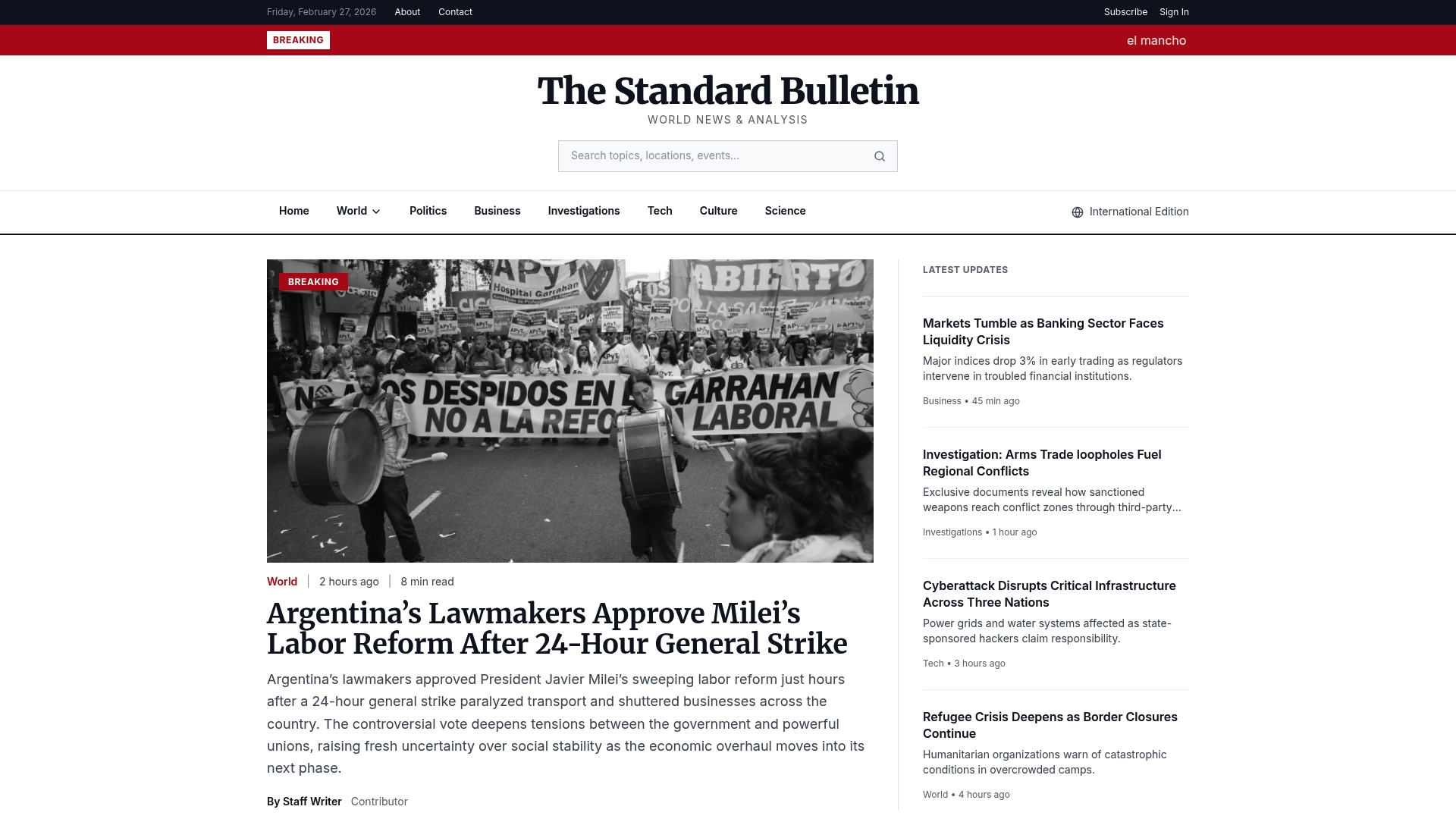
Explore our comprehensive coverage at Standard Bulletin for breaking news and in-depth reports that align with the principles of reliable sourcing and rigorous evaluation discussed here. Benefit from carefully curated updates and analytical commentary that connects the dots across geopolitics, economics, and global affairs. Don’t let uncertainty delay your understanding—visit Standard Bulletin now to transform raw information into actionable insights and stay informed with a platform that prioritizes credibility, context, and clarity.
Frequently Asked Questions
How can I establish reliable data sources for political analysis?
To establish reliable data sources, prioritize information from government statistics offices, international organizations, and peer-reviewed databases. Begin by listing your available sources and assessing them for content validity, reliability of collection, and convergent validity to ensure their trustworthiness.
What steps should I take to collect relevant political information?
Start by creating a clear collection strategy that outlines what specific information you need, such as policy announcements or voting patterns. Organize your data as you collect it by documenting the source, date, and context to help streamline your analysis later.
How do I evaluate the credibility of political sources?
Use the CRAAP test to evaluate sources by checking their Currency, Relevance, Authority, Accuracy, and Purpose. Assign ratings to each source based on these criteria to establish a systematic approach for determining their reliability in your analysis.
What methods can I use to synthesize findings into actionable insights?
Identify patterns across your sources and organize your findings around key questions related to your analysis. Create a summary that maps out the core themes, supporting evidence, and gaps, transforming raw data into insights that can influence political decisions.
How can I validate my conclusions from political analysis?
Utilize triangulation by cross-verifying your conclusions through multiple sources and methods. Document any contradictory evidence to ensure that your findings are robust and not one-dimensional, aiming to consult at least three varied sources for each conclusion you draw.