Global affairs rarely unfold without skillful negotiation. Diplomacy remains the primary framework for nations to exchange interests and ideas peacefully, navigating crises from Berlin to Tokyo. For policy professionals and geopolitical analysts, understanding diplomacy as the official channel through which sovereign states pursue their interests peacefully provides a foundation for interpreting conflict resolution, treaty formation, and public influence. This overview clarifies diplomatic structures, their evolving forms, and why they are essential in shaping international relations.
Table of Contents
- Defining Diplomacy In Global Affairs
- Types Of Diplomacy And Key Distinctions
- How Diplomacy Shapes International Relations
- Responsibilities And Skills Of Diplomats
- Modern Challenges Facing Global Diplomacy
Key Takeaways
| Point | Details |
|---|---|
| Role of Diplomacy | Diplomacy is crucial for peaceful communication and negotiation between sovereign states, focusing on resolving issues without resorting to conflict. |
| Types of Diplomacy | Different forms of diplomacy, including bilateral, multilateral, public, and economic diplomacy, serve distinct purposes in fostering international relations. |
| Modern Challenges | Today's diplomats face complex challenges such as digital transformation, the influence of non-state actors, and the demands of social media scrutiny, which require adaptability in their approach. |
| Diplomat Skills | Effective diplomats need a diverse skill set, including negotiation, cultural understanding, and crisis management to navigate the evolving landscape of global diplomacy. |
Defining Diplomacy in Global Affairs
Diplomacy is fundamentally about how nations communicate and negotiate with each other. At its core, diplomacy represents the official channels through which sovereign states pursue their interests peacefully.
Diplomacy involves representatives discussing and resolving issues across borders. These discussions cover conflict resolution, trade agreements, environmental concerns, technology standards, and security threats. The goal remains consistent: maintain peace while advancing national interests.
The practice operates through defined structures and personnel. Diplomats are accredited officials authorized to represent their governments. Embassies serve as permanent diplomatic missions, headed by ambassadors who manage day-to-day relations. Consulates handle consular services like visa issuance and legal assistance for citizens abroad.
Diplomacy encompasses multiple levels of engagement:
- Bilateral diplomacy: Direct negotiations between two countries
- Multilateral diplomacy: Negotiations involving three or more nations
- Track two diplomacy: Unofficial discussions between non-governmental actors
- Summit diplomacy: High-level meetings between heads of state or government
The practice requires specific skills beyond mere negotiation. Diplomats must balance tact and honesty, presenting their nation's position while remaining open to compromise. They work to encourage international cooperation on shared challenges—pandemics, climate change, economic crises—that no single nation can solve alone.
Diplomacy as conventionally understood emphasizes peaceful interaction through institutional frameworks. These institutions include the United Nations, regional organizations, and bilateral diplomatic channels that have developed over centuries of international practice.
Diplomacy differs from other forms of statecraft. Unlike military force or economic coercion, diplomacy relies on dialogue and agreement. Unlike propaganda, it seeks genuine understanding rather than manipulation. Modern diplomacy increasingly involves non-state actors—international organizations, corporations, civil society groups—alongside traditional government representatives.
The scope of diplomatic work continues expanding. Today's diplomats address cybersecurity threats, pandemics, refugee crises, and artificial intelligence governance alongside traditional concerns like territorial disputes and trade. This evolution reflects how international affairs now touch virtually every aspect of human activity.
Pro tip: When analyzing international negotiations, distinguish between a nation's public diplomatic statements and its private negotiating positions—understanding this gap reveals true priorities and informs better geopolitical analysis.
Types of Diplomacy and Key Distinctions
Diplomacy operates through multiple distinct forms, each serving specific purposes in international relations. Understanding these types helps explain how nations achieve different objectives through different channels.
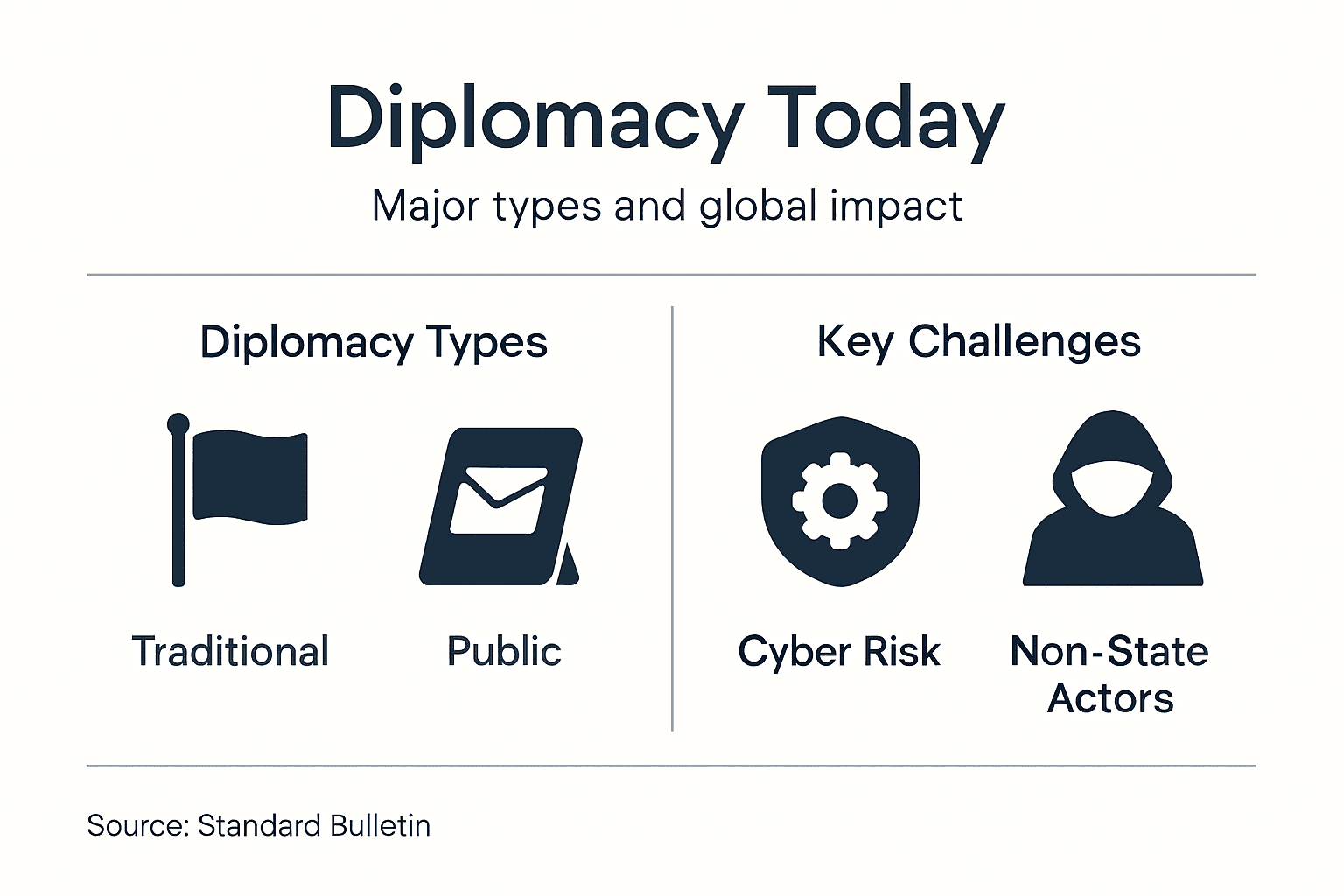
The fundamental divide splits into traditional diplomacy and public diplomacy. Traditional diplomacy involves formal interactions between sovereign states conducted by accredited diplomats through established legal frameworks. Public diplomacy, by contrast, engages foreign populations directly to influence opinion and build grassroots support for national interests.
Beyond this basic division, diplomacy branches into specialized categories:
- Classical diplomacy: Traditional state-to-state negotiations focused on peace and bilateral relations
- Multilateral diplomacy: Negotiations involving three or more nations through international organizations
- Economic diplomacy: Using trade agreements and financial arrangements to advance national interests
- Cultural diplomacy: Promoting a nation's values and soft power through arts and educational exchange
- Parliamentary diplomacy: Engagement between legislators from different nations
- Military diplomacy: Strategic communication between defense establishments
- Public diplomacy: Direct messaging to foreign audiences through media and cultural initiatives
Diplomacy's distinct types reflect its multidisciplinary nature and grounding in international law. Each type targets different outcomes—managing conflict, standardizing legislation, or facilitating economic cooperation.
Traditional diplomacy operates within strict legal frameworks emphasizing state sovereignty and treaty obligations. Diplomats follow formal protocols, adhere to diplomatic immunity rules, and work through established channels. This approach moves slowly but produces binding commitments.
Public diplomacy operates differently. It uses media campaigns, cultural exchanges, educational programs, and social media to reach ordinary people. Governments aim to build favorable public opinion that indirectly supports their political objectives. This approach moves faster and adapts quickly to changing circumstances.
These forms increasingly overlap. A government might simultaneously conduct trade negotiations (economic diplomacy) while launching cultural exchange programs (cultural diplomacy) and media campaigns (public diplomacy). Modern geopolitical strategy requires coordinating multiple diplomatic forms toward unified national objectives.
Here's how major types of diplomacy differ on core characteristics:
| Diplomacy Type | Main Actors Involved | Typical Channels Used | Primary Objective |
|---|---|---|---|
| Traditional | Government diplomats | Formal embassies, treaties | State negotiation and security |
| Public | Governments, public figures | Media, cultural exchanges | Shaping foreign public opinion |
| Economic | Trade officials, economists | Trade missions, summits | Advancing national economies |
| Cultural | Cultural envoys, artists | Events, exchanges, partnerships | Building soft power and trust |
Traditional and public diplomacy complement each other in contemporary international relations, creating a more comprehensive diplomatic toolkit than either approach offers alone.
Pro tip: Track which diplomatic type a nation emphasizes in specific regions—nations prioritizing military diplomacy signal different strategic interests than those emphasizing cultural or economic diplomacy.
How Diplomacy Shapes International Relations
Diplomacy operates as the foundational mechanism through which nations structure their interactions and manage global affairs. Without diplomatic channels, international relations would collapse into isolated state interests with no framework for cooperation.
Diplomacy is central to international relations, shaping everything from international law to world order. It enables cooperation by creating shared norms, facilitating treaty negotiations, and establishing institutions that govern state behavior. When diplomacy functions effectively, it transforms potential conflicts into manageable disputes.
The practical impact shows across multiple dimensions:
- Treaty formation: Diplomats negotiate binding agreements on trade, security, environment, and human rights
- Institution building: Diplomatic work creates international organizations that coordinate collective action
- Conflict prevention: Negotiation channels reduce misunderstandings that could escalate to violence
- Legal culture: Diplomacy sustains respect for international law across diverse political systems
- Status quo maintenance: Diplomatic practices help preserve stability between established powers
Diplomacy acts as the engine room of world politics by facilitating international cooperation and legal order. Diplomats represent state interests while simultaneously building frameworks that constrain how aggressively states can pursue those interests.
Consider how diplomatic networks prevent escalation. When tensions rise between nations, pre-existing diplomatic relationships and communication channels provide off-ramps from conflict. Ambassadors can deliver warnings, clarify intentions, and propose compromises before situations spiral toward military confrontation.
Diplomacy also structures global hierarchies and power distributions. Through diplomatic recognition, trade agreements, and institutional voting arrangements, nations establish their relative status. Diplomatic success can elevate rising powers while diplomatic isolation can constrain declining ones.
The role extends to peacebuilding and crisis management. After conflicts end, diplomats negotiate peace agreements, coordinate peacekeeping forces, and facilitate reconciliation. These efforts shape whether post-conflict societies stabilize or collapse back into violence.
Diplomacy fundamentally determines whether the international system functions through cooperation or chaos—it is the difference between managed competition and uncontrolled conflict.
Pro tip: Analyze diplomatic appointments and embassy staffing levels to assess which regions nations prioritize—investment in diplomatic presence reveals genuine strategic interests more accurately than public rhetoric.
Responsibilities and Skills of Diplomats
Diplomats carry multifaceted responsibilities that extend far beyond attending formal dinners and delivering speeches. Their work determines whether nations achieve their objectives peacefully or face escalating tensions.
Diplomats represent their country's interests abroad through negotiating treaties, managing embassy operations, and reporting on political developments. They protect citizens overseas, facilitate economic and political engagements, and provide consular services like visa processing and legal assistance. Each responsibility requires distinct expertise and careful attention to shifting geopolitical circumstances.
The core responsibilities include:
- Treaty negotiation: Drafting and securing agreements on trade, security, environment, and human rights
- Political reporting: Analyzing local developments and transmitting intelligence to home governments
- Consular services: Issuing visas, protecting nationals, and handling legal matters
- Economic engagement: Promoting trade relationships and investment opportunities
- Crisis management: Responding to emergencies affecting citizens or bilateral relations
- Intelligence gathering: Observing regional developments and reporting trends
Successful diplomats possess a demanding skill set. Ideal diplomat qualities include analytical thinking, excellent writing and speaking abilities, and negotiation prowess. Beyond technical competencies, effective diplomats demonstrate cultural understanding, attention to detail, stamina, and resilience under pressure.
These professionals must balance competing demands. They advocate fiercely for their nation's interests while building genuine relationships with counterparts from potentially adversarial countries. They write detailed reports for home government review while maintaining discretion about sensitive negotiations.
Cultural competence separates adequate diplomats from exceptional ones. Understanding local history, religious sensitivities, business practices, and political dynamics allows diplomats to navigate complex social terrain. A misstep—an offensive gesture, a cultural misunderstanding, or inappropriate timing—can damage relationships that took years to build.
Leadership at diplomatic posts requires managing diverse teams. Ambassadors coordinate between political officers, economic specialists, defense attachés, consular staff, and administrative personnel. Interagency coordination becomes critical when security threats, trade disputes, or humanitarian crises demand unified response.
Diplomatic effectiveness depends less on formal authority and more on building trust, demonstrating integrity, and understanding what counterparts actually need versus what they publicly demand.
Pro tip: When evaluating a diplomat's effectiveness, examine their continuity in post and relationship-building patterns—diplomats who spend years in regions develop deeper understanding than those rotated frequently, enabling more nuanced negotiations.
Modern Challenges Facing Global Diplomacy
Today's diplomats navigate unprecedented complexity that their predecessors never encountered. Traditional state-to-state negotiation remains important, but it now competes with digital disruption, non-state actors, and hyperconnected publics demanding real-time responses.
Modern diplomacy undergoes fundamental changes driven by digitization and involvement of diverse actors beyond governments. Social media amplifies public sensitivity to diplomatic decisions, forcing officials to consider how negotiations play to domestic audiences while conducting actual talks. Diplomats must now manage tensions between individual stakeholder needs and broader state requirements simultaneously.
Key challenges reshaping diplomatic practice:
- Digital transformation: Managing secure communications while utilizing modern technology for efficiency
- Non-state actors: Engaging international organizations, corporations, NGOs, and civil society groups alongside traditional state diplomacy
- Social media scrutiny: Conducting sensitive negotiations while every statement faces public analysis and criticism
- Emotional publics: Addressing populations that demand immediate responses and expect emotional engagement, not just formal statements
- Complex stakeholders: Balancing interests of multiple domestic constituencies alongside foreign policy objectives
Globalization introduces new actors challenging traditional state-centric diplomacy. Governments now engage non-state actors for development projects, disaster relief coordination, and public outreach. This mix of inherited state-to-state practices and innovative interaction forms creates coordination challenges diplomats must navigate.
Digital tools offer both opportunity and vulnerability. Encrypted communications enable secure negotiations, but cyber threats expose sensitive diplomatic cables. Social media allows direct public engagement, but viral misstatements damage relationships instantly. Diplomats must develop new technical competencies while maintaining tradecraft.
The speed of modern affairs compresses decision timelines. Crisis situations demand immediate responses before full analysis completes. Traditional diplomatic deliberation—carefully drafted cables, measured responses, strategic silence—now appears inadequate when crises unfold in real time across global networks.
Non-state actors complicate diplomatic negotiations. International organizations, multinational corporations, and influential NGOs now shape outcomes that governments cannot control unilaterally. Diplomacy increasingly requires building coalitions with private and civil society partners.
Modern diplomacy must balance centuries of traditional practice with rapid adaptation to digital realities, transparent governance demands, and complex multi-stakeholder engagement that didn't exist a generation ago.
Pro tip: Monitor how governments respond to diplomatic crises through official channels versus social media to understand their actual priorities—slow official responses combined with rapid social media engagement often reveal which audiences policymakers genuinely fear.
This summary highlights modern diplomatic challenges and their global impacts:
| Challenge | Key Difficulty | Global Impact |
|---|---|---|
| Digital communication | Cybersecurity threats, rapid pace | Increased risk, need for agility |
| Non-state actor influence | Coordination across diverse interests | More complex negotiations |
| Social media scrutiny | Instant public reaction | Heightened diplomatic sensitivity |
| Multiple stakeholders | Balancing varied domestic priorities | Policy fragmentation risk |
Stay Ahead in Global Affairs with Standard Bulletin
Understanding the complex role of diplomacy in shaping international relations is essential for anyone following today's fast-changing world. The challenges diplomats face such as digital disruption, social media scrutiny, and managing multiple stakeholders require timely insights and in-depth analysis to grasp their real impact on geopolitics and global stability. If you want to decode diplomatic developments and never miss how these shifts influence global politics, economics, and conflicts, staying updated is critical.
Explore expertly curated breaking news and detailed reports on diplomacy, international crises, and foreign policy at Standard Bulletin. Benefit from concise summaries and investigative coverage that reveal the true stakes behind diplomatic negotiations and the evolving global order. Visit Standard Bulletin now to empower your understanding of world affairs and be ready to act as global dynamics unfold.
Frequently Asked Questions
What is the primary role of diplomacy in global affairs?
Diplomacy serves as the official channel through which nations communicate and negotiate peacefully to pursue their interests, facilitating conflict resolution, trade agreements, and international cooperation.
How does modern diplomacy differ from traditional diplomacy?
Modern diplomacy not only involves state-to-state negotiations but also engages non-state actors like international organizations, corporations, and civil society groups, adapting to a rapidly changing global landscape.
What are the key challenges faced by diplomats today?
Diplomats today face challenges such as digital communication risks, the influence of non-state actors, social media scrutiny, and managing multiple stakeholders, all requiring agility and adaptability in their responses.
What skills are essential for successful diplomats?
Successful diplomats should possess strong analytical thinking, excellent communication skills, negotiation prowess, cultural understanding, and the ability to build relationships and trust across diverse political landscapes.